
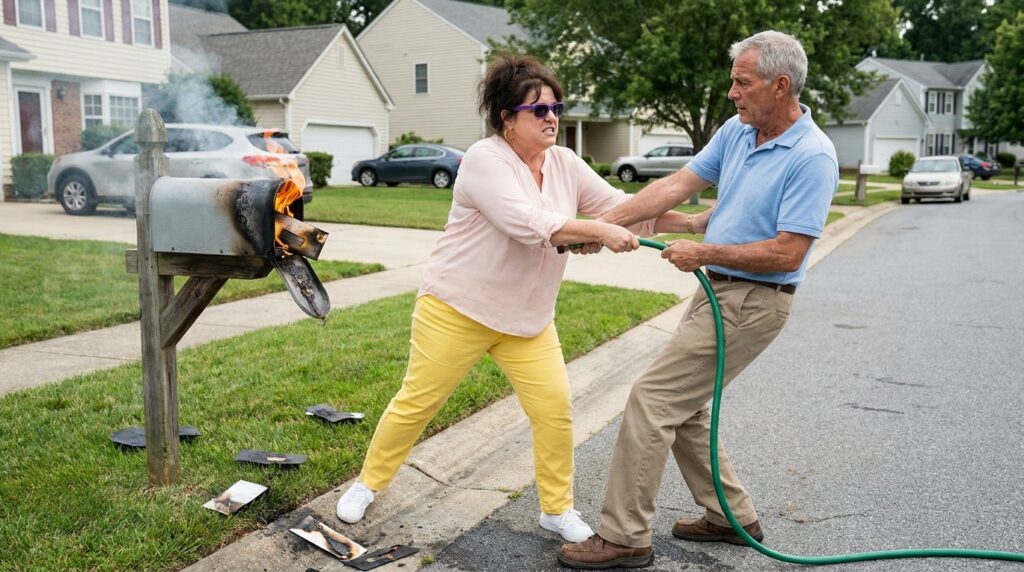
Chapter 2: The Envelope
Daniel carried the damaged envelope onto the porch without saying another word.
Karen remained near the curb.
She folded her arms across her pale-pink blouse and watched him with narrowed eyes.
“What?” she called. “Why are you looking at me like that?”
Daniel didn’t answer.
He laid the wet mail across a clean towel on the porch table.
There were three ordinary pieces of mail: a utility bill, a credit-card advertisement, and a grocery-store circular.
The fourth envelope was different.
It was from a regional hospital.
The return address was partly burned, but Daniel recognized it immediately.
His mother’s name was visible beneath the soot.
Margaret Hayes.
Daniel’s mother had been dead for nearly three years.
He picked up the envelope with trembling fingers.
It wasn’t addressed to him.
It wasn’t even current mail.
It had been forwarded to his house because Margaret’s old address was still associated with the property.
Daniel opened it carefully.
Inside was a letter from the hospital’s records department concerning an old medical bill and a reimbursement that had never been processed.
The amount wasn’t enormous.
But the letter contained something more important.
A notice explaining that the hospital had located additional records connected to Margaret’s final treatment.
Daniel sat down.
For several seconds, the street seemed strangely quiet.
He had spent years wondering whether his mother’s last weeks had been handled properly. She had been too sick to explain everything herself, and Daniel had never been able to get a complete set of records.
Now, three years later, an answer might have arrived in an envelope Karen had nearly destroyed.
Daniel looked back toward the curb.
Karen was still standing there.
“You knew there was mail in here,” he said.
Her expression hardened.
“I knew you had mail.”
“You knew there was mail?”
“I don’t check people’s envelopes.”
“But you put a flame against the box.”
Karen looked away.
The argument that had started over trash cans suddenly seemed painfully small.
For months, Karen had complained about Daniel’s garbage cans.
She claimed they remained visible too long after collection day. She had photographed them, left handwritten warnings, and reported him to the HOA.
Daniel had moved the cans.
He had followed the published schedule.
He had even attended an HOA meeting where the board confirmed that his placement was within the rules.
Karen hadn’t accepted the decision.
She had taken it personally.
And now, in a moment of retaliation, she had nearly destroyed something Daniel could never replace.
He carefully placed his mother’s letter on the table.
Then he called the police.
Karen’s face went pale.
“You’re calling the police over a mailbox?”
Daniel looked at the scorched metal sitting beside the curb.
“No,” he said quietly.
“I’m calling them because you set it on fire.”