CHAPTER 3: RETALIATORY ESCALATION
The morning sun hit the galvanized mailbox like a flare off polished chrome.
Arthur reached the end of his driveway at six forty-five, the grass along the culvert stiff and grey with dry dust. Inside the steel box lay three crisp, oversized white envelopes, each bearing the red embossed seal of the Whispering Oaks Enforcement Committee. He didn’t open them on the road. He carried them back to the bed of his truck, laid them flat on the steel tailgate, and used his pocketknife to slice the top folds clean.
The first notice cited an illegal perimeter fence height: East boundary post exceeds maximum thirty-six-inch residential allowance by four point five inches.
The second cited unauthorized commercial equipment storage on residential land: 1998 Ford F-250 observed parked on unpaved surface for more than seventy-two consecutive hours.
The third was a formal fine of five hundred dollars for unapproved exterior lighting, alleging his barn security lantern illuminated neighboring bedrooms past ten at night.
Each citation carried a forty-eight-hour cure window, after which daily compound penalties would accrue directly against his property title. Attached to the back of the third notice was a printout from the community’s private social network. The post, written under Brenda Vance’s verified profile, was titled Protecting Our Ridge: Why Fire Safety Cannot Be Compromised. It detailed an unnamed “hostile resident” who was “endangering forty-two homes by harboring dry brush and threatening legal violence against volunteer board officers.”
Arthur looked up from the paper. Across the cleared swath, Brenda’s upper deck windows glinted in the morning glare. She was standing behind the glass, a white coffee mug in her hand, watching him through the empty gap where his cypress canopy used to sit.
He didn’t tear the papers. He walked into his study, booted up his desktop terminal, and pulled up his automated home maintenance archive.
Within twenty minutes, he had cross-referenced the claims against fifteen years of verified records. The east fence had been built in 2014 using county agricultural variance #882, fully permitted and signed off by the county building inspector to keep feral hogs out of the creek bed; the original stamped permit was sitting in folder four. The Ford truck was parked under a timber carport built in 2009, registered under his farm use exemption, and hadn’t touched the grass since May. The barn lantern ran on an astronomical timer hardwired into a digital circuit that killed power at exactly nine-forty-five every evening, backed up by four years of hourly smart-meter utility logs.
He printed every receipt, every county permit seal, and every digital timer log, binding them with heavy steel clips.
At nine-fifteen, a dark blue sedan pulled into his gravel turnaround. Tom Briggs got out of the driver’s side, pulling a heavy aluminum tripod, a set of digital tree calipers, and a increment borer from his trunk. Behind him came a silver subcompact driven by Elaine Cho, a land-use attorney Arthur had hired from the county seat twenty miles west.
Elaine didn’t wear a suit. She wore work boots, denim, and a canvas briefcase that looked older than her practice. She walked straight to the fence line without greeting Arthur, her sharp eyes scanning the stumps, the tire ruts, and the open expanse up to Brenda’s deck.
“She didn’t leave you much margin, did she?” Elaine said, her voice dry and precise.
“Eleven feet,” Arthur said, handing her the three fresh violation notices along with his bound rebuttals. “She issued these at five this morning.”
Elaine flipped through the citations, her mouth curving into a thin, cold line. “Retaliatory enforcement within forty-eight hours of a formal preservation demand. Texas district courts do not look kindly on boards that use code citations as personal truncheons. I’ll draft the formal response before noon. If they try to file a lien against your title based on these, we file for an immediate temporary restraining order.”
Meanwhile, Tom Briggs was on his knees at stump number twelve, his digital caliper clamped across the sapwood. He drove the increment borer into the heartwood of the fallen trunk, pulling out a slender cylinder of pale pine tissue.
“Zero rot,” Tom called out, his voice carrying across the quiet dirt. “Ring density is tight—about two millimeters per year. Moisture content in the sapwood is nineteen percent. This tree wasn’t tinder, Art. It was healthier than the oaks on her side of the line.”
He filled out the ISA Trunk Formula evaluation sheet on a metal clipboard: 18 specimens, Arizona Cypress, mature height 32 feet, trunk diameter average 22 inches. Structural integrity: Excellent. Replacement value: $175,400.
“That’s the replacement cost,” Elaine noted, taking a copy of the worksheet. “Under the civil practice code, if we prove intentional trespass and malice, the treble damages multiplier applies. We aren’t looking at a two-thousand-dollar settlement, Arthur. We are looking at over five hundred thousand dollars in direct liability.”
At one-thirty that afternoon, while Tom was finishing his survey notes, a courier truck pulled up and delivered a sealed legal envelope to Elaine’s car. It was the preliminary discovery packet produced by the HOA’s insurance defense counsel in response to the preservation notice—a mandatory disclosure of preliminary records.
Elaine sat on the tailgate of Arthur’s truck, unsealing the packet with a brass letter opener. She pulled out a small black thumb drive and plugged it into her field laptop.
Arthur stood beside her, leaning over the screen as the file directory opened. Among the hundreds of administrative PDF invoices and meeting minutes was an unredacted export of the board’s internal instant messaging thread from late March—four months before the saws ever touched his land.
Elaine scrolled down to a timestamped exchange from March 14th at 2:14 PM.
Brenda V.: “We need to figure out a way to get rid of Pendelton’s tree wall. It’s dropping my property valuation by at least forty grand because I can’t market the lake view.”
Gary T.: “Brenda, those cypress are on his deeded lot. The county plat shows his line goes all the way to the road shoulder. We don’t have jurisdiction there.”
Brenda V.: “I don’t care about his deed. Find a loophole. Use the summer fire protocol, use code enforcement, use anything. Just get a crew in there when he’s down in Temple for his father’s memorial anniversary. Once they’re down, he can’t put them back.”
Arthur stared at the screen. The afternoon glare burned against the glass, highlighting the crisp, unmistakable text of the message. The entire “emergency fire hazard” narrative wasn’t a misguided administrative error or an overzealous safety check. It was a calculated, deliberate conspiracy to destroy private property for a view.
“There it is,” Elaine said softly, her finger resting on the trackpad. “The decoy falls apart right here. She didn’t act for the community. She manufactured a safety emergency to steal your sightline.”
Arthur’s hand closed into a fist at his side, his knuckles turning white against the canvas of his jacket. “She thought if she cut them while I was gone, I’d take two thousand dollars and go away.”
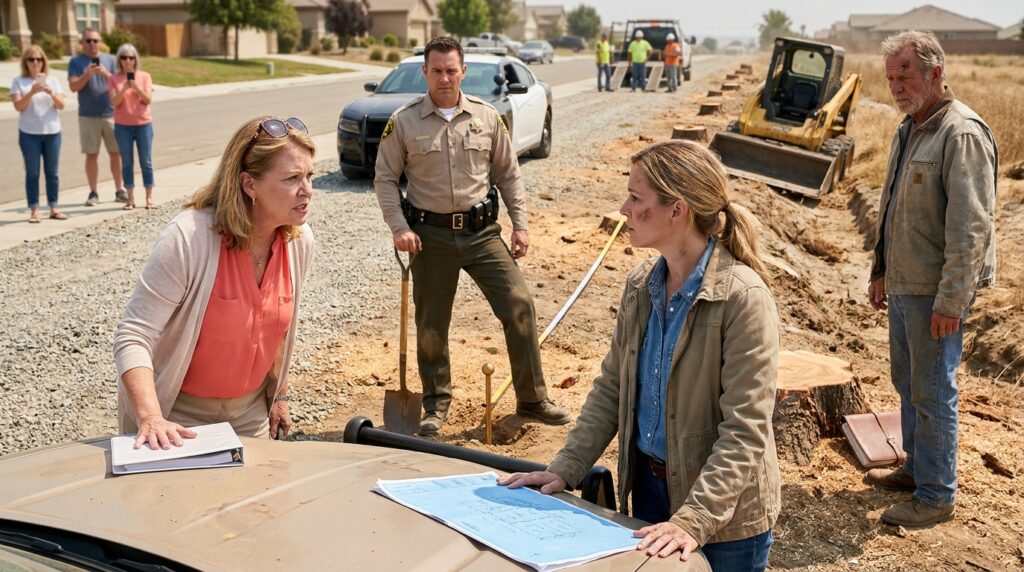
“She thought you were a quiet old man who wouldn’t read his deed,” Elaine said, locking the thumb drive into a steel evidence case. “She has no idea that this thread just stripped the HOA of its legal indemnity. But we aren’t done yet, Arthur. This proves her malice, but we still need to establish the absolute boundary line in front of the county sheriff before she tries to clear the stumps.”
Arthur turned and looked back at the eighteen stumps bleeding in the sun. The midpoint of the fight was behind them, but the true confrontation at the physical line was only just beginning.