CHAPTER 2: THE GLASS THRESHOLD
The laminated card swung against the cedar picket like a pendulum in the dry draft.
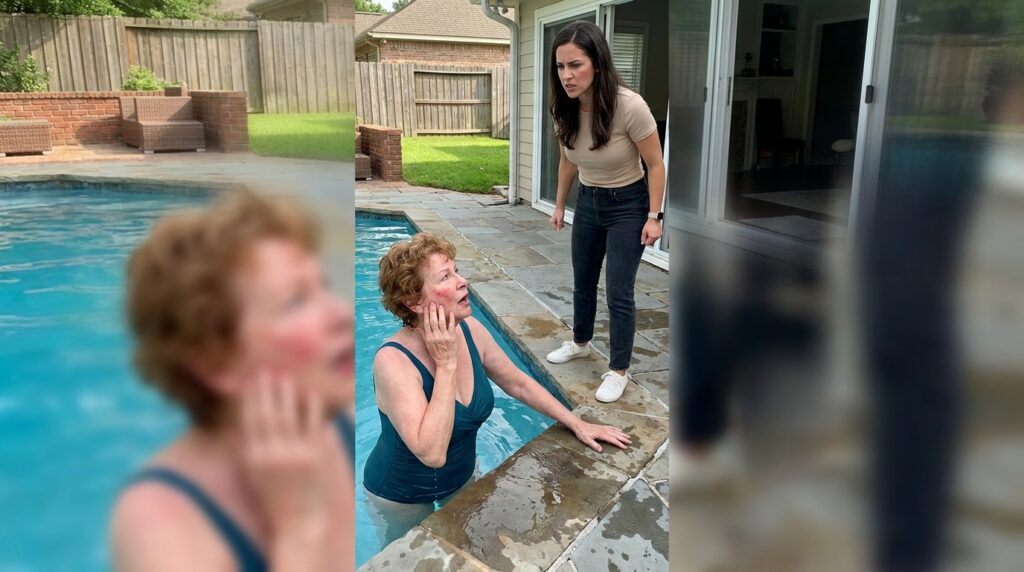
Brenda didn’t look back at the gate. She hauled her second knee over the pool’s bullnose edge, the wet nylon of her teal suit dragging heavily against the porous travertine. Water pooled beneath her shins, instantly leaching gray minerals out of the sealant and leaving dark, greasy smears across the stone.
“You touch that card and you’re tampering with a county notice,” she choked out. The crimson dye had settled into the fine creases around her nasolabial folds, turning the lower half of her face into a mottled, scarlet mask. She shoved herself upright on shaking legs, water sluicing down her calves into the grout lines. “Don’t you look at me like that. You don’t know the first thing about this subdivision. Not one damn thing.”
I didn’t reach for the card. I didn’t shift my weight from the balls of my feet. Every tactical manual on structural disputes tells you the same thing: the moment you break eye contact to inspect their bait, you surrender the physical line.
“You’re dripping across forty feet of private masonry,” I said, my voice leveled to a low, dry cadence that barely cleared the hum of the filter pump behind the shed. “The gate was padlocked from the inside with a hardened brass hasp. That makes this criminal trespass under state statute 810.09.”
“It’s an easement!” Her voice spiked, cracking against the high cedar perimeter. She took two aggressive, sloshing steps toward me, her bare heels slapping hard on the sun-baked stone. She thrust a dripping index finger within six inches of my sternum. “Mr. Henderson gave me full access back in 2014. We had an arrangement. An official agreement! The association has legal authority over contiguous drainage parcels, and this basin sits square on the municipal runoff route!”
She was lying, but she was lying with the rehearsed fluency of someone who had practiced the terminology in front of a bathroom mirror.
“Step back,” I said.
“Call them!” Brenda shrieked, spraying fine droplets of chlorinated spit across the front of my shirt. “Go on! Pick up your little phone and call the township! Tell them Brenda Vance is in the Henderson pool! Tell them I’m having an acute anaphylactic reaction to whatever illegal industrial defoliant you dumped in the skimmer basket!”
She lunged forward—not to strike, but to crowd the narrow flagstone corridor between the pool coping and the sliding glass track. Her intent was obvious: force a physical shove, generate contact on my camera feed, and turn an open-and-shut boundary violation into mutual battery.
I didn’t push. I pivoted three inches on my left heel, dropping my center of gravity and letting her momentum carry her toward the glass.
Before her wet shoulder could strike the tempered pane, I slid my left hand into the recessed handle of the exterior screen and yanked the heavy aluminum frame into the lock-pocket. The latch engaged with a sharp, heavy clack. In the same continuous motion, I pulled the secondary deadbolt lever through the reinforced strike plate.
Brenda’s palms slammed flat against the glass.
“Open this door!” she yelled, her breath fogging the treated low-E coating. “My inhaler is in my tote bag by the front walk! You’re refusing emergency aid on your property! That’s gross negligence! That’s reckless endangerment!”
Through the pane, the reflection of the midday sun cut across her distorted features. The red dye wasn’t swelling; it was drying into a chalky, scarlet crust where her foundation had absorbed the tracer base. There was no hives pattern, no airway constriction in the rhythm of her vocal cords—only the raw, calculating fury of an enforcer who realized her leverage was evaporating.
Without taking my eyes off her, I reached into my back pocket with my right hand. I unlocked the screen of my phone with my thumb, tapped the direct-line bypass to the county communications center, and brought the receiver to my ear.
“County dispatch,” a flat voice answered after two rings.
“This is 4122 Whispering Pines Lane,” I said, speaking clearly into the mic while holding Brenda’s gaze through the glass. “I have an active intruder on my secure patio enclosure. Subject entered by forcing the rear cedar latch. She is currently refusing to vacate the perimeter, making fraudulent claims of chemical exposure, and attempting to force entry through the rear glass.”
“You little bitch,” Brenda hissed through the seal of the door frame.
“Caller,” the dispatcher asked, keyboard clatter audible in the background. “Are you in immediate physical danger?”
“No,” I replied, cold and steady. “She is contained on the exterior patio. But send a supervisor. She is displaying a falsified county easement placard at the gate.”
Brenda’s eyes widened slightly at the mention of the placard. The theatrical panic dropped from her shoulders for a fraction of a second, replaced by something far colder: recognition. She didn’t look at her spotted face in the reflection anymore. She looked past me, through the dark interior of the living room, toward the street where the faint, distant yelp of a siren cleared the outer boulevard.
Then her hand dropped from the glass, leaving five smeared streaks of red tracer paste across the surface. She turned her head toward the gate, not to flee, but to check whether the small black recording lens mounted on her own keychain was still pointed at the door.