
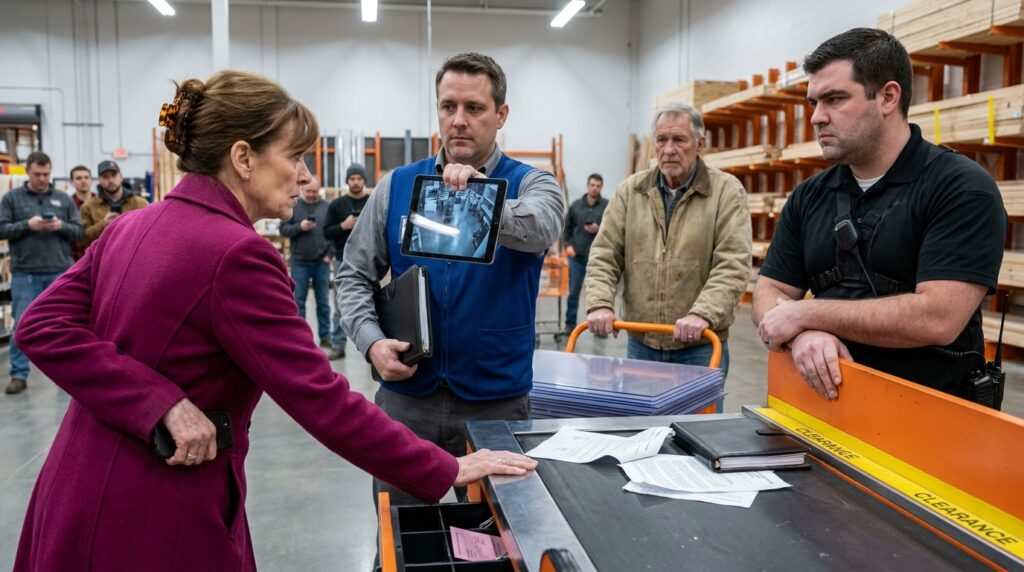
CHAPTER 5: THE CLEARING OF THE AISLE
Marcus Brooks didn’t hesitate. He took one deliberate step into Evelyn’s peripheral vision, his heavy frame blocking her path back toward the commercial service counter.
“Mrs. Vance-Giles,” Marcus said, his voice dropping into a flat, practiced tone of industrial enforcement. “Your Diamond-Tier commercial profile has been flagged and deactivated. Under Store Policy Section 8, attempted bribery of floor staff, intentional property interference, and verbal harassment of customers carry an immediate, permanent trespass notice from all Apex regional properties.”
Evelyn’s head snapped back, her eyes wide behind her designer frames, dark mascara smudging slightly near the inner corners. “You can’t trespass me! I have three thousand dollars of river rock staged in Bay Four!”
“That order is canceled,” David Chen said, his voice smooth, cold, and entirely unbothered. “Your card on file will be credited within three business days, minus the restocking fee for the held freight. If you step back into this building or onto the parking lot apron, local law enforcement will handle the removal.”
Evelyn looked around the wide concrete aisle. To her left, two line contractors in grease-stained canvas vests stood silently, their arms crossed over their chests, their eyes fixed on her with cold, unyielding indifference. To her right, Nina Reyes was already sliding the stamped receipt into Arthur’s invoice pouch, the printer closing with a quiet metallic snap. Behind her, a dozen shoppers held their phones at chest height, the small glass lenses tracking her every twitch.
For three long seconds, time seemed to stretch thin inside the high steel bay. The distant hum of the lumber yard’s diesel forklift, the smell of sawdust and stale exhaust, the cold glare of the overhead halogen lamps—everything settled like heavy silt into the concrete floor. Evelyn’s lips moved once, forming a silent word that withered before it reached the air. She pulled her magenta coat tight around her shoulders, snapped her phone into her purse, and turned on her heel.
Her leather boots squeaked sharply against the sealed concrete deck, a hollow, rhythmic sound that echoed all the way down the main thoroughfare toward the automatic sliding glass doors. Marcus walked two paces behind her, his hands resting lightly on his utility belt, escorting her step by step until the rubber-edged glass panels parted and swallowed her into the bright morning glare of the parking lot.
The silence that remained in Lane 1 was clean, stripped of tension.
David Chen turned to Arthur, his expression relaxing into a weary, human warmth. “I apologize for the delay, Arthur. Freight desk gets hectic on Saturdays, and some people assume money buys the rules.”
“No need for apologies, David,” Arthur said, his voice as steady as an iron beam. “The system worked once the tape was turned on.”
David smiled faintly, nodding toward the heavy flatbed cart. “Need a hand getting those panels out to your trailer? I can have one of the yard guys bring the flatbed truck around.”
“I’ve got two hands and a good hitch,” Arthur said, reaching into his coat pocket. His thumb brushed against the brass edge of his late partner’s caliper, the metal warm now against his skin. “And we’ve got young people waiting at the site with hammer racks.”
One of the line contractors who had been watching from Lane 2 stepped across the yellow floor marker, grabbing the front end rail of Arthur’s cart. “I’ll take the lead handle, pop. Seven hundred pounds of polycarbonate gets steering-heavy on the asphalt ramp.”
Arthur looked at the man, a young guy with sawdust in his beard and a faded union cap pulled low over his forehead. Arthur gave a single, quiet nod. “Appreciate the arm.”
Together, they wheeled the flatbed cart down the wide concrete apron toward the sunlit exit bay. The heavy steel casters hummed smoothly over the expansion joints, a rhythmic, steady clatter that sounded like work getting done.
Outside, the cool morning air blew fresh across the asphalt parking lot, carrying the smell of pine timber and dry autumn leaves. Arthur’s old Ford pickup sat waiting near the loading zone, its rusty ball hitch gleaming in the pale sunlight. Beyond the store fence, three miles down the bypass, the timber posts for the youth center greenhouse were standing straight in their wet lime footings, waiting for the clear, unbent glass to catch the sky.
Arthur pulled his canvas collar up against the breeze, adjusted his grip on the steel bar, and kept moving forward.