CHAPTER 5: PUBLIC REVERSAL AND CONSEQUENCES
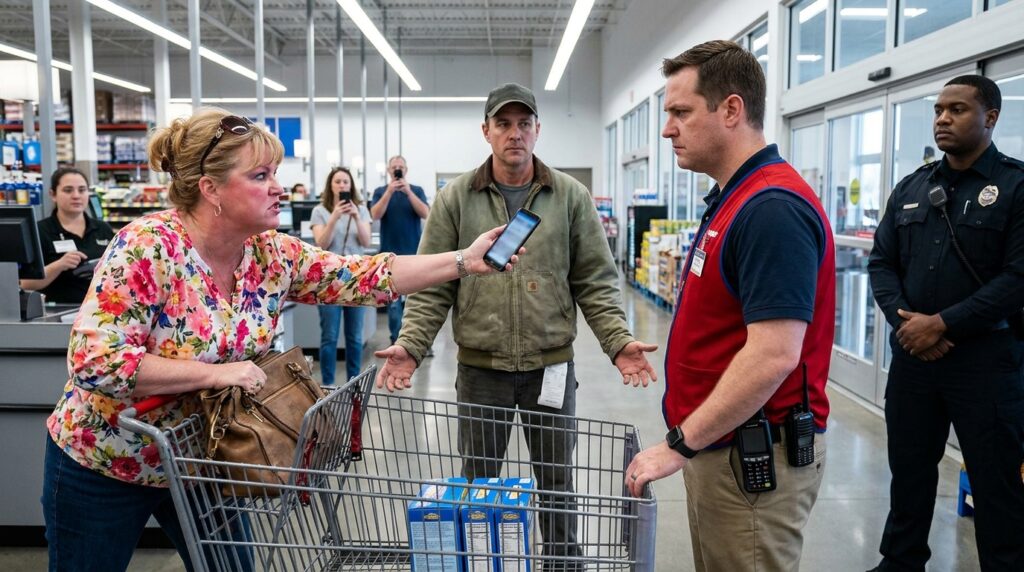
David Lee blinked, his hand holding the validation voucher remaining suspended between them for a brief second. A quiet, genuine warmth softened the tight lines around his eyes.
“Associate Miller already has his badge back, Mr. Hayes,” David said softly, stepping closer and placing the voucher gently onto the top box of infant formula inside the wire basket. “Security brought him back to his aisle two minutes ago. And this voucher is yours—not as a payoff, but because you deserve to leave this building with every ounce of respect you walked in with.”
Marcus looked down at the small printed card resting on the blue cardboard box. The black print was crisp, clean, and unhurried.
Behind them, the double sliding glass doors hissed open, letting in a sudden gust of cool afternoon air that swept across the polished concrete floor, carrying the faint scent of sun-warmed asphalt and autumn trees. The last echoes of Brenda’s sharp heels had vanished into the parking lot. The ring of bystanders had begun to disperse, their quiet murmurs settling back into the ordinary rhythm of Sunday grocery shopping: wheels squeaking against floorboards, register scanners chiming, cashiers calling out totals.
The thirty-year-old ghost that had clung to the back of Marcus’s neck since childhood—that cold, suffocating memory of being trapped under a floor manager’s heavy, accusing stare—did not dissolve in a flash of thunder. It simply grew faint, light, and thin, like an old photograph left too long in the sun.
“Thank you, David,” Marcus said quietly.
He placed his hands back onto the cool rubber handle of his shopping cart. The metal grid felt solid, balanced, and responsive as he guided it forward. He did not rush. He walked at his own steady pace, his work boots making a quiet, rhythmic thud against the floor as he passed the empty space where Brenda had blocked his path only fifteen minutes earlier.
The security officer standing near the vestibule nodded to him as he passed, holding open the outer stanchion line.
“Have a good afternoon, sir,” the officer said, his tone low and respectful.
“You too,” Marcus replied.
He stepped through the automatic sliding doors into the bright, open glare of the afternoon sun. The expanse of the parking lot stretched out before him, rows of cars reflecting the sky, their glass windshields glinting under the wide blue horizon.
Marcus pushed the cart down the asphalt aisle toward his faded blue pickup truck parked near the outer perimeter light pole. He unlocked the tailgate, the heavy steel latch dropping with a familiar, metallic clunk that echoed in the quiet air. One by one, he lifted the three bulk boxes of baby formula and placed them carefully onto the clean bed liner, followed by his bags of household goods.
When the cart was empty, he rolled it smoothly into the metal return bay, ensuring the front wheel locked neatly into the frame of the cart ahead of it.
He reached into his jacket pocket and pulled out the folded thermal receipt. He unfolded it slowly, feeling the smooth, uncreased paper between his fingers. The timestamps, the serial codes, the itemized numbers—all printed in neat, unflinching black ink—stood as a quiet record of an ordinary afternoon that had refused to be twisted into someone else’s spectacle.
He didn’t throw the receipt away. He folded it once, gently, and placed it inside his dashboard glove compartment alongside his vehicle registration and maintenance logs.
Marcus climbed into the driver’s seat, pulled the door shut, and turned the key in the ignition. The engine turned over with a steady, reassuring rumble. As he shifted into gear and pulled out of the parking stall, he caught a brief glimpse of a black SUV idling near the far edge of the lot, its driver’s side door shut, the figure inside sitting motionless behind a dark windshield.
Marcus didn’t linger on the image. He turned his eyes back to the open road ahead, merging smoothly into the afternoon traffic as the sun cast long, warm shadows across the pavement.