CHAPTER 1: THE SEVERED LINE
The smell of raw cypress resin was thick enough to taste before the engine even cut out in the gravel turn.
Arthur Pendelton rested his hands on the worn leather of the steering wheel, watching the pale dust settle over the windshield of his Ford. Through the clear patch, the northern sky looked raw and vacant. For twenty-two years, that horizon had been a solid wall of deep forest green—eighteen Arizona cypress planted with his father in the dry clay of 2002, their lower branches intertwined so tightly not even the winter draft could cut through.
Now there was only open air and sunlight pouring onto the dry dirt.
He stepped out of the cab, the soles of his work boots crunching against the blue-grey gravel. The heat hit him like an open kiln door, carrying the sharp, turpentine stink of bleeding wood. He didn’t rush. He walked the forty yards to the fence line with a measured stride, his eyes fixed on the raw, yellow wounds rising barely twelve inches above the topsoil.
Eighteen stumps. Cut clean across the root collars with a long-bar saw, the golden sawdust still damp where it piled against the iron fence posts.
Stapled to the cedar post near the corner pin was a bright yellow plastic sleeve. Arthur pulled the galvanized staple with his pocketknife, extracted the folded paper inside, and unfolded it against the hood of his truck. The letterhead was crisp: Whispering Oaks Homeowners Association—Office of the Board. It cited Subsection 4 of the Emergency Fire Prevention Protocols, declared the cypress line an immediate wildfire hazard under summer drought conditions, and noted a two-thousand-dollar good-faith clearing allowance deposited toward his annual dues.
At the bottom, in tight, looping blue ink: Hope this resolves the sightline issue amicably, Arthur. —Brenda Vance, President.
A ice-filled glass clinked across the open space.
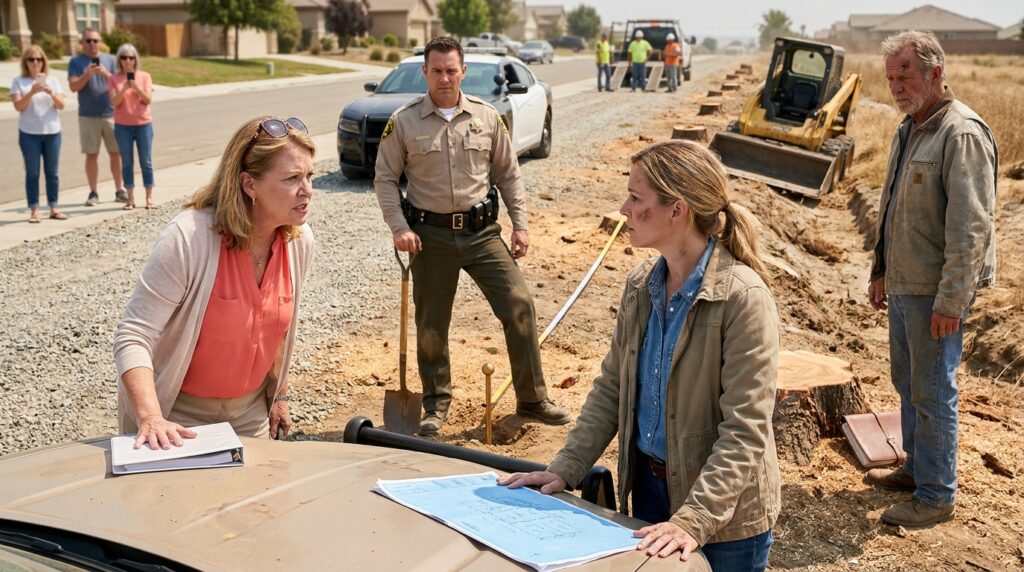
Arthur turned his head slowly. Fifty yards north, past the cleared swath of sawdust, Brenda Vance stood on the cedar deck of her newly built two-story ranch. She wore oversized black sunglasses and a bright coral blouse that caught the midday light. She held a tall tumbler of iced tea in one hand, her elbow resting on the top rail as she looked out across his property toward the distant blue line of the valley floor—a view that had been completely invisible forty-eight hours ago.
She didn’t look away when he caught her eye. Instead, she lifted her glass half an inch in a silent, comfortable gesture of possession.
Arthur didn’t raise his voice. He didn’t move toward the fence line. He walked back to the cab of his truck, reached behind the bench seat, and pulled out his steel measuring tape, his brass marking pins, and a heavy Nikon DSLR with a fixed 50mm lens.
He started at the eastern corner pin. He knelt in the hot dirt, set the steel tape against the center of the first stump, and took three overlapping photographs: one close-up of the annual growth rings showing twenty-two years of dense tissue, one showing the directional cut angle of the saw teeth, and one wide shot framing the stump against the corner marker and the clear sky above Brenda’s deck.
As the shutter clicked for the forty-fifth time, he heard the soft rustle of dry grass behind him.
Brenda had come down the slope, her leather sandals stopping two feet short of the low string-line. She held a white folder tucked under her arm, her expression set in a practiced, neighborly smile that didn’t reach the dark lenses covering her eyes.
“I saw you pulled in, Arthur,” she said, her voice carrying the smooth, rehearsed cadence of a public meeting chair. “I know it looks a bit drastic right now, but the board had a certified fire-risk assessment done on the perimeter. Those trees were dry tinder. In July, one lightning strike on that north fence line takes out three houses on the ridge.”
Arthur stayed on one knee, setting a brass survey pin into the soil next to the nineteenth stump to mark the precise edge of the root collar. He did not look up immediately. He carefully noted the diameter—twenty-four inches—in his leather field log.
“Where is the engineer’s report, Brenda?” Arthur asked softly.
Brenda tapped the white folder under her arm. “It’s all documented in the board files. We acted under emergency protocol. The two thousand is already credited to your account. We just need you to sign the standard release waiver so we can clear the slash.”
Arthur stood up, his canvas work jacket heavy despite the heat. He looked past her shoulder at the fresh boot prints—size twelve work boots—imprinted in the soft clay near the property line where the cutting crew had operated.
“This fence sits eleven feet south of the HOA easement, Brenda,” Arthur said, his voice flat, dry, and completely devoid of heat. “My father set these brass pins in 1982.”
Brenda’s smile tightened at the edges, her posture hardening as she adjusted the clipboard under her arm. “Community safety overrides individual preference, Arthur. You should have trimmed them years ago.”
Arthur clicked the lens cap back onto the camera and looked her squarely in the eye. “I am going to let the county land plat answer that statement.”