
CHAPTER 1: THE CHOKE POINT
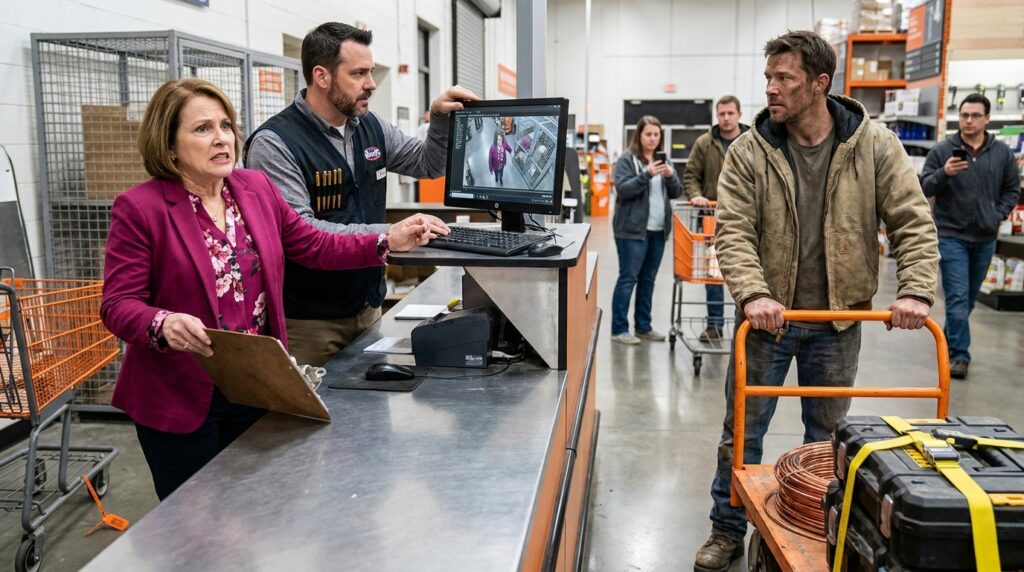
The galvanized steel frame of a heavy retail shopping cart slammed into the metal register divider with a sound like a dropping iron gate, locking Marcus Vance’s two-thousand-dollar flatbed in place before the rubber tires could clear the lane.
“Don’t move that cart an inch,” Evelyn Pryor said. Her voice carried the sharp, grating pitch of dry iron grinding on dry iron, cutting cleanly through the ambient roar of the weekend supply warehouse—the high-pitched whine of the forklift, the distant thud of dropping dimensional lumber, and the rhythmic, hollow beeps of eight active registers.
Marcus didn’t flinch. His thick, calloused palms remained grounded on the worn rubber sleeve of his flatbed’s handle. He could feel the fine dust of drywall grit shifting under his thumbs. He didn’t turn his head fast; seven years of pulling copper wire through tight conduits had taught him that sudden movements wasted muscle and gave away leverage. He simply shifted his weight, his steel-toed boots scuffing the stained concrete floor, and looked at the woman standing in the gap.
Evelyn was braced between the stainless-steel cashier desk and the impulse-display rack, her knees locked, her knuckles white where she gripped the top bar of her cart. The magenta floral pattern of her jacket stood out against the gray industrial background like fresh paint sprayed over rust. Around her neck, a gold-plated lanyard clip clinked against her oversized sunglasses every time she took a short, shallow breath. In her left hand, held high like a badge of office, was a thick leather-bound clipboard.
“Ma’am,” the cashier said. Tyler was nineteen, his hands hovering nervously over the rubber keys of his point-of-sale terminal. The paper ribbon from the receipt printer was still warm, dangling three inches from the slot. “The register is cleared. He paid.”
“He paid for what you saw,” Evelyn snapped, her eyes tracking Marcus’s worn canvas jacket, lingering on the dark oil stain near the left pocket and the tarnished, scratched brass buckle of his tool belt. She turned slightly to face the six shoppers standing behind her in line, her voice expanding to fill the entire corridor. “He stacked two industrial copper wire spools right up against the scanner screen while you were entering the code for the brass fittings. I watched him do it from the back of Aisle Four. He slid two high-end brushless tool combo kits straight across the lower rack without presenting them.”
A heavy silence settled over Register Four. The family directly behind Evelyn—a man in a clean polo shirt holding a box of lawn fertilizer and his teenage son—stepped back half a pace, their eyes darting from Marcus’s dusty boots to the heavy yellow security tags visible through the wire mesh on the lower shelf of the flatbed.
Marcus slowly reached into his right jacket pocket. His fingers touched the crisp, stiff edge of the thermal receipt paper. He didn’t pull it out yet. He felt the cold air drifting from the automatic exit doors twenty feet away, carrying the faint smell of wet asphalt and hot diesel exhaust from the parking lot.
“The receipt is in my hand,” Marcus said. His voice was low, rasping slightly from a morning spent breathing attic insulation, stripped of any anger or panic. “The transaction is closed. Move your cart out of the lane.”
“You aren’t going anywhere until security audits every serial number on that lower shelf,” Evelyn said, her phone slipping out from behind the clipboard, the camera lens already pointed directly at Marcus’s chest. “I know how this works. You contractor types think because you spend money here every week, the rules don’t apply to you. You count on distracted kids at the register.”
Tyler’s face flushed red. “I scanned the bottom rack with the wireless wand, Mrs. Pryor…”
“You thought you did!” she cut in, her voice rising to a sharp, triumphant edge as the head of store security turned the corner at the end of the aisle. “Look at the cart, Tyler! Look at the way those tool boxes are angled! He overlapped the labels!”
Marcus didn’t argue. He pulled the paper from his pocket and laid it flat on the stainless steel counter, his heavy thumb pinning the top corner to keep the draft from taking it. But as his eyes traced the ink lines down to the bottom timestamp, his pulse spiked—not from fear, but from the sudden, jarring detail printed in dark red ink along the margin: a pre-applied store audit flag that Tyler hadn’t keyed in, carrying a security timestamp logged four minutes before Marcus had even reached the register line.